Research
<Introduction>
Our laboratory conducts research in the field of space environment and planetary science, focusing on the following three areas. Please also refer to the research field introduction in the RCAST Master Book.
Research on (planetary) space weather phenomena that cause space environment changes
“Space weather” refers to changes in the state of the solar surface, outer space, and planetary spheres that can affect the performance and reliability of space and ground-based technical systems and endanger human life and health. Space weather phenomena include auroras and cosmic radiation fluctuations. The space surrounding planets, which are plasma worlds, varies depending on whether or not the planet has a global magnetic field, so expanding planetary space weather research from Earth is an urgent necessity. By combining observations from probes and numerical experiments, we aim to understand space weather phenomena extended to planets.
Space climate research to understand the effects of solar (stellar) activities on the planetary surface environment
An atmosphere is essential for maintaining a habitable surface environment with oceans like Earth. We are seeking to elucidate the stellar XUV radiation and intrinsic magnetic field strength dependence of planetary atmospheric escape into space, which is an important issue for understanding the atmospheric retention conditions of Earth-like planets, by developing a unique numerical model that integrates knowledge of planets in the solar system and applying it to exoplanets.
Toward strategic exploration of the Martian environment
As international space exploration progresses from the Moon to Mars, Japan is also beginning strategic exploration of the Martian environment.There is also growing momentum for private companies to participate in space exploration. We are utilizing our expertise in the space science obtained from participation in Mars missions with NASA and other organizations to develop future exploration plans.
<Research Topics>
Geospace Environment
The supersonic plasma flow from the sun, known as the solar wind, interacts with the Earth’s atmosphere and magnetic field, causing various variations in the space environment surrounding our planet (geospace). This interaction facilitates a variety of space weather phenomena, such as aurorae, radiation belt variations, and the formation of large-scale current systems. On Earth, a number of satellites and ground-based observation networks have been established. We investigate these space weather phenomena using multi-point satellite observations (in-situ observations of plasma and electromagnetic fields) and satellite-ground conjunction measurements, aiming especially at understanding responses to solar wind variations. The insights obtained are useful not only for Earth but also for understanding the space environment around other planets and their moons. They are also expected to form the foundation for future space exploration and planetary environment prediction.
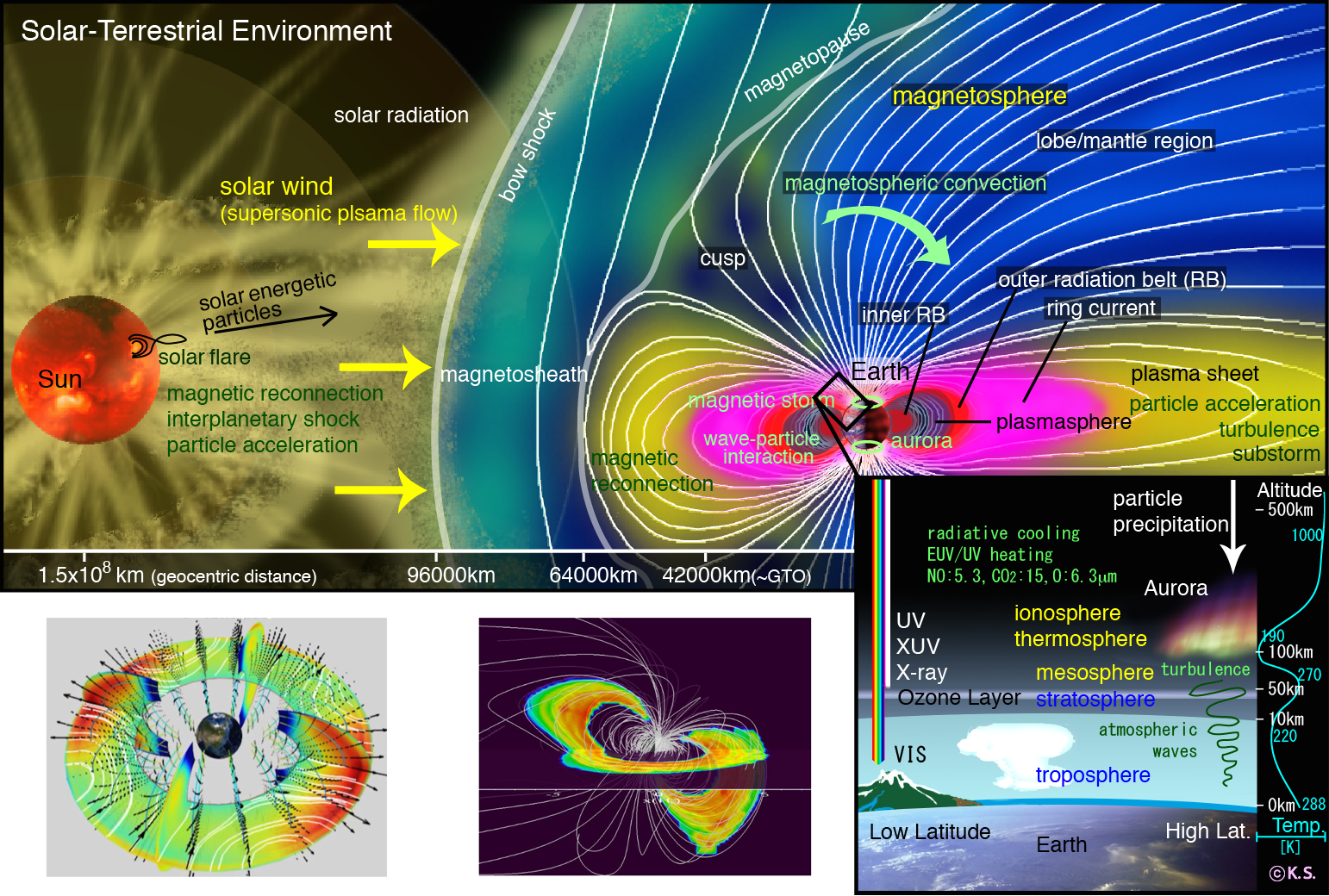
Figure 1.
(Top) Schematic diagram of the geospace environment and the solar-terrestrial system. Within the region dominated by the Earth’s magnetic field (magnetosphere), plasmas of various properties coexist. Energy coupling across the different plasma regimes and regional interactions occur through variations in the electromagnetic fields.
(Bottom right) Energy and mass transfers into the boundary between space and the Earth’s atmosphere are shown.
(Bottom left) Results from related numerical simulations (from left: ring current and radiation belts).